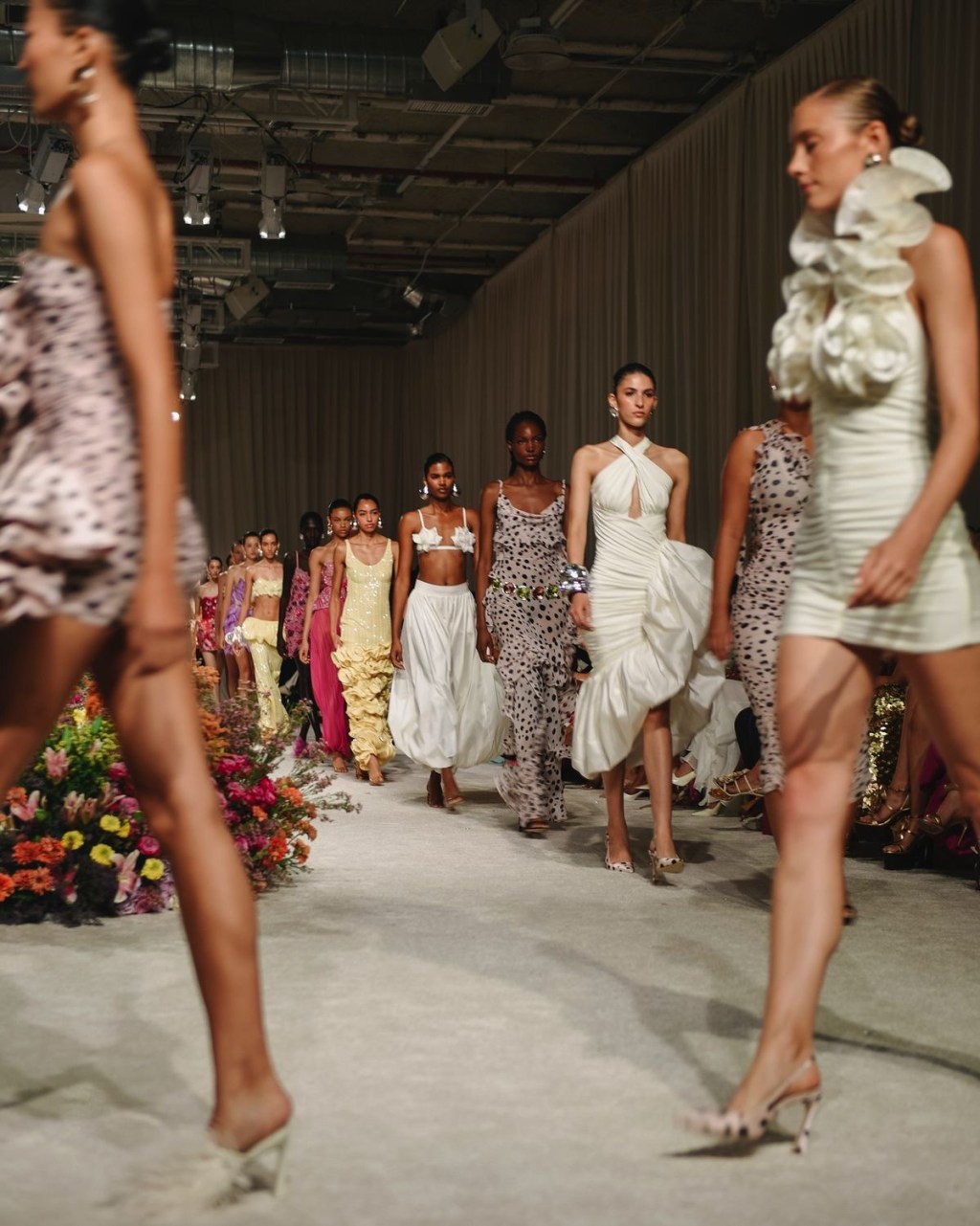
Fashion Week has been around in Paris since the late 1800s before expanding to New York, Milan, and London. In our modern world, it has not lost its purpose but rather changed it. Shows were traditionally centered around those who worked within the industry such as buyers, editors, designers and journalists. Social media has bridged the gap between consumers and fashion houses as viewers are able to experience backstage, see celebrities, and watch runway clips. This has caused brands to consider Fashion Week as more than solely a presentation of a collection. Every piece can become part of a deeper conversation. Social media has expanded Fashion Week’s reach, giving brands the opportunity to transform runway moments into a shared experience for consumers globally.
Today, Tiktok decides if something is worth the investment. The shows are meticulously put together from the guest list and seating arrangements to the atmosphere, “essentially business meetings dressed in silk” according to The Buying Instinct (Feb. 2026). These factors influence how we perceive a collection, especially after reading what editors had to say on the event. Customers purchase pieces for the association, status, brand identity, all reinforced by social media. Fashion Week is more than just the clothing being presented on the runway, it provides designers with the opportunity to create experiences. The music, location, lighting, models, styling and atmosphere all contribute to the story a designer wants to convey. Creating a memorable experience immensely boosts a consumer’s engagement in a world where they are exposed to new content constantly.
There has clearly been a shift from restricted to open access. Influencers with thousands of followers are able to give their audiences front row seats to top tier luxury brand shows like never before. Media enhances what has already been established by fashion houses, it simply speeds up the rate at which the aesthetic is distributed. According to the Journal of Fashion Marketing and Management, fashion retail is moving to increasingly use both online and physical spaces to build relationships with their customer markets.
How do influencers fit into such an elevated environment? Influencers are able to move products in less than a day’s time before Fashion Week has even ended. However, it is extremely difficult for fast form content to hold consumers’ attention and trust. A well-known brand like Gucci or Louis Vuitton is able to effectively hold people’s attention as they bring authority and credibility that make consumers comfortable spending their money. Working on building trust lowers perceived risk, signaling that the piece being presented is something worth investing in rather than a part of a fleeting trend. In other words, social media platforms provide shows with longer economic lives.
Celebrity presence can heavily influence the amount of media an event gets, directly affecting the revenue a show gets. For instance, Thai actors Orm Kornnaphat and Lingling Kwong gathered nearly $45 million in media related revenue, about half of the $90 million earned in media value from Dior’s Spring/summer show in 2026 according to Observer (Sep. 2026). Western celebrities struggle to raise audience engagement compared to their overseas counterparts such as those from Asia who are able to break the ceiling. Specifically, Orm Kornnaphat obtained a 116% engagement rate according to Influencity (Mar. 2026).
Fashion shows need large amounts of attention but, Tiktok changes that. Shows are able to combine this while maintaining the scarcity of luxury brands. TikTok connects millions of consumers to shows while luxury brands control who is able to witness the shows as an in-person experience. Celebrities and influencers can open the visibility of a collection while keeping the actual products difficult to obtain. This scarcity increases the perceived value of a collection while significantly raising the number of viewers.
Fashion Week creates a harmonious ecosystem between customers, media, designers and editors each increasing the other’s productivity. Looking at specific numbers, influencers were able to increase search results for designers to 312% and generated over 4.2 billion online impressions combined. These content creators are also able to build long-lasting brand equity as seen in the Alaïa show. Deep, long-form content is created when the collection features masterfully crafted pieces. Additionally, fashion houses get their return on making celebrity influencers the center of the show when 15 minute runways are turned into 48 hours of content creation. Another example of this is Chanel’s relationship with Jennie from BLACKPINK. Influencity (Mar. 2026) writes that Chanel brings heritage and breathtaking backdrops while Jennie provides cultural electricity.
Consumers have gained a much more significant role in Fashion Week as access to show content has expanded. People can still follow collections, discuss new looks and participate in the excitement without physically being in the front row. This accessibility gives brands instant insight into which looks and ideas are grabbing market attention. Thus, creating a connection between an industry that once seemed unobtainable and a wider audience. Consumers are still able to engage with the ideas and conversations created by fashion houses through the collections presented without needing to purchase specific pieces themselves.
Fashion Week has evolved to keep itself relevant in a modern digital world. The way in which people interact with Fashion Week is bound to continue changing, but its ability to display creativity and capture attention gives this event a consistent purpose within the fashion industry.


Leave a Reply